
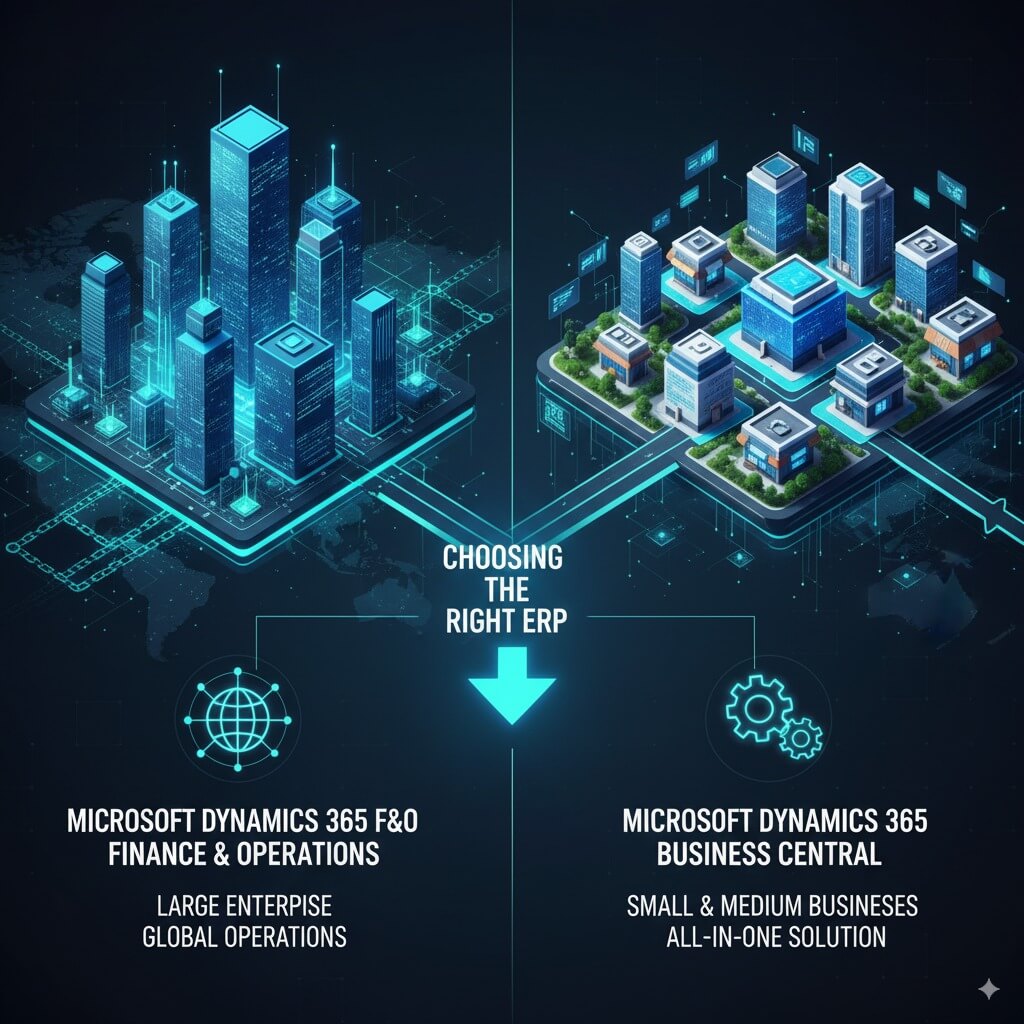
Microsoft offers two powerful ERP (Enterprise Resource Planning) solutions under the Dynamics 365 suite: Finance & Operations (F&O) and Business Central (BC). While both are designed to streamline operations, they serve very different business needs.
If you’re evaluating ERP systems, understanding the differences between Dynamics 365 F&O and Business Central is essential to avoid costly mistakes and ensure the system aligns with your company’s size, complexity, and growth strategy.
What is Dynamics 365 Finance & Operations (F&O)?
Table of Contents
ToggleDynamics 365 F&O is a cloud-based ERP built for medium to large enterprises. It unifies finance, supply chain, and manufacturing operations into one intelligent system.
Best for: Enterprises with complex global operations.
Key strengths: Advanced finance, supply chain management, manufacturing, and compliance.
For a comprehensive look at how this module supports Saudi enterprises under Vision 2030, read our guide on Dynamics 365 Finance and Operations.Scalability: Handles multi-company, multi-currency, multi-language environments.
Industries: Manufacturing, distribution, retail, logistics, and regulated industries.
What is Dynamics 365 Business Central (BC)?
Business Central is a comprehensive ERP for small to mid-sized businesses (SMBs). It combines finance, sales, purchasing, inventory, and project management in one system.
Best for: SMBs seeking an affordable, easy-to-implement ERP.
Key strengths: Core ERP functionality with user-friendly deployment.
To understand how Business Central delivers cloud ERP for Saudi SMEs, explore our guide on Dynamics 365 Business Central.Scalability: Supports growing businesses but is not designed for highly complex, global operations.
Industries: Retail, professional services, small manufacturers, wholesale trade.
Key Comparison: Dynamics 365 F&O vs Business Central
Feature / Aspect Dynamics 365 Business Central (BC) Dynamics 365 Finance & Operations (F&O) Target Audience Small to mid-sized businesses Medium to large enterprises with complex needs Deployment Cloud-first (simpler, faster implementation) Cloud-first (enterprise-level with hybrid options) Financial Management Core finance, accounting, and reporting Advanced finance, compliance, and global tax support Supply Chain Basic procurement & inventory control Advanced SCM, logistics, demand forecasting Manufacturing Light manufacturing functionality Full discrete, lean, and process manufacturing Scalability Regional growth Multi-country, multi-currency, multi-language Customization Easier, SMB-friendly extensions Deeper customization for enterprise requirements Integration Integrates with Microsoft 365 & Power Platform Integrates with full Microsoft ecosystem & advanced AI Cost Lower subscription/licensing costs Higher licensing and implementation costs Implementation Time Weeks to months Months to years (depending on complexity) Best Fit Companies seeking affordable, quick ERP Enterprises needing global, enterprise-grade ERP
Key Comparison: Dynamics 365 F&O vs Business Central
Feature / Aspect Dynamics 365 Business Central (BC) Dynamics 365 Finance & Operations (F&O) Target Audience Small to mid-sized businesses Medium to large enterprises with complex needs Deployment Cloud-first (simpler, faster implementation) Cloud-first (enterprise-level with hybrid options) Financial Management Core finance, accounting, and reporting Advanced finance, compliance, and global tax support Supply Chain Basic procurement & inventory control Advanced SCM, logistics, demand forecasting Manufacturing Light manufacturing functionality Full discrete, lean, and process manufacturing Scalability Regional growth Multi-country, multi-currency, multi-language Customization Easier, SMB-friendly extensions Deeper customization for enterprise requirements Integration Integrates with Microsoft 365 & Power Platform Integrates with full Microsoft ecosystem & advanced AI Cost Lower subscription/licensing costs Higher licensing and implementation costs Implementation Time Weeks to months Months to years (depending on complexity) Best Fit Companies seeking affordable, quick ERP Enterprises needing global, enterprise-grade ERP When to Choose Business Central
You’re a small or mid-sized business looking for a cost-effective ERP.
Your operations are regional or single-country, not global.
You need fast implementation with minimal complexity.
You want an ERP tightly integrated with Microsoft 365 tools (Excel, Outlook, Teams).
When to Choose Finance & Operations (F&O)
You’re a large enterprise with multiple subsidiaries or locations worldwide.
Your business requires complex manufacturing and supply chain management.
You operate in regulated industries that demand compliance and audit-ready systems.
You need scalability to manage thousands of users, currencies, and transactions daily.
Common Ground: What Both Systems Share
Despite their differences, F&O and BC share Microsoft’s core advantages:
Cloud-based flexibility on Azure.
Integration with Power BI, Power Platform, and Microsoft 365.
Strong security, scalability, and updates from Microsoft.
A user-friendly interface with role-based dashboards.
To understand the fundamental concepts of ERP and how Microsoft Dynamics 365 is redefining business management, read our guide on what is Microsoft Dynamics ERP.
Conclusion: Business Central vs Finance & Operations
Business Central is ideal for growing SMBs that want to move beyond spreadsheets or entry-level accounting systems into a professional ERP.
Finance & Operations is the solution for large, complex enterprises seeking a global, enterprise-grade ERP to unify finance, supply chain, and manufacturing.
For a complete overview of the platform’s core capabilities and benefits, explore our detailed guide on what is Dynamics 365 Finance & Operations (F&O).
Choosing between the two depends on your company’s size, complexity, growth strategy, and industry requirements.
With the right Microsoft partner (like Trax Group), your ERP choice becomes not just a software implementation but a foundation for digital transformation.


No comment