
Table of Contents
ToggleWhat is the difference between CRM and ERP?
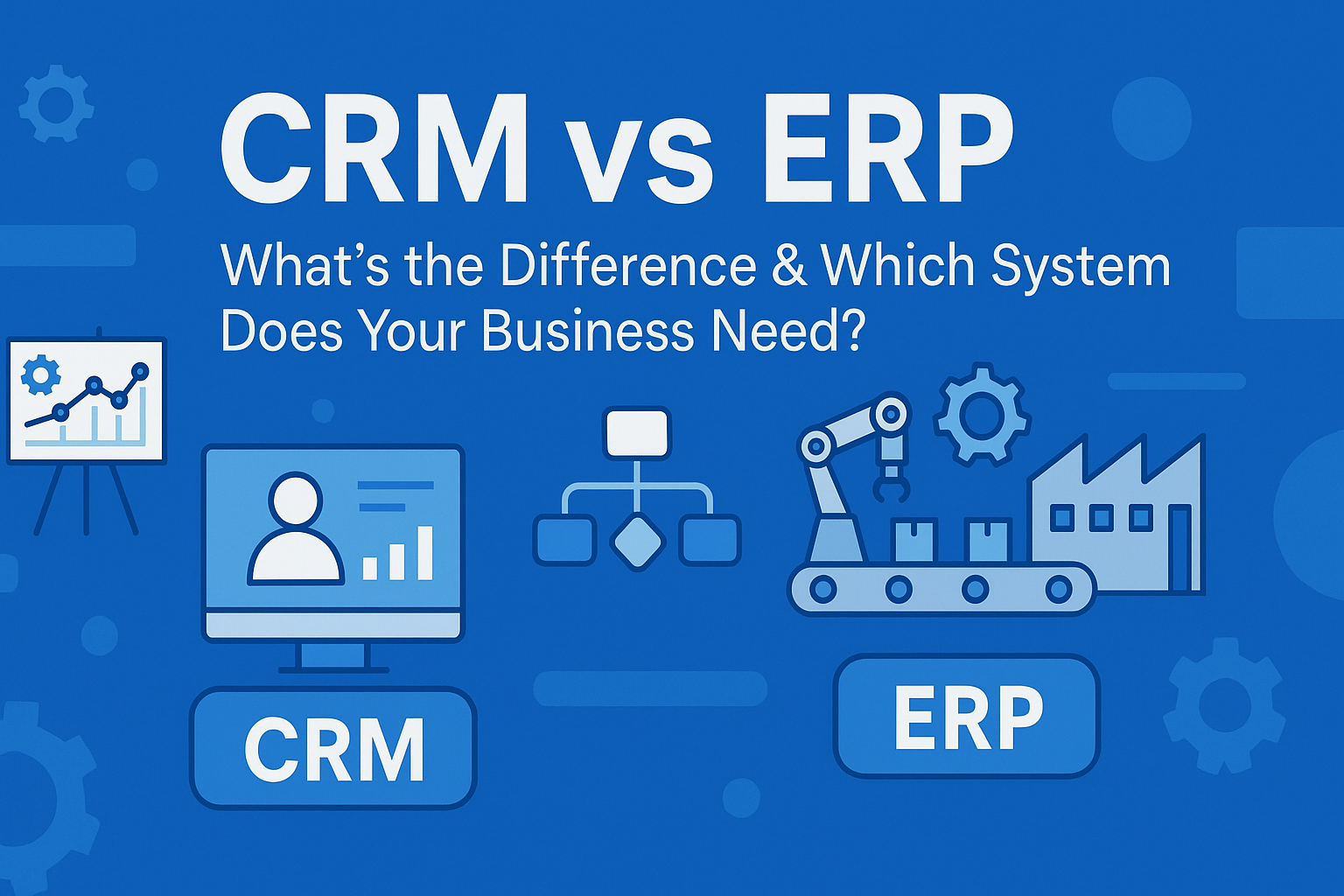
Most businesses know they need “systems,” but they aren’t sure if they need CRM or ERP first.
This confusion makes digital transformation take longer and often leads to buying the wrong tool before the real problem is clear.
Even though both CRM and ERP store data and automate tasks, they solve different main problems.
To build an architecture that encourages growth instead of stopping it, you need to know the difference. First, talk about the business impact. Then, define entities. After that, get into modules, data, scenarios, and real-world steps for making decisions.
When it makes sense, we’ll link to other articles like Digital Transformation in the Manufacturing Industry and Enterprise System Integration Services so that readers can learn more later.
These internal links help leaders connect the choice to use CRM/ERP to their larger digital strategy.
Why CRM vs. ERP is important
1.1 Technology Is Now a Revenue Question, Not Just an IT Question
In most companies, CRM and ERP are no longer “back-office tools.”
They directly influence how much revenue you close, how fast you deliver, and how efficiently you use cash.
A weak CRM means you do not understand your customers.
A weak ERP means you cannot reliably fulfill what you sell.
Insight:
Choosing between CRM and ERP is essentially choosing whether you want to fix how you win business or how you deliver business first.
1.2 The Strategic Roles of CRM and ERP
At a macro level, CRM is about top-line growth, while ERP is about bottom-line efficiency.
CRM helps you sell more to the right customers; ERP helps you deliver with less waste and better control.
Insight:
High-growth organizations often lead with CRM, while asset-heavy or margin-sensitive industries often prioritize ERP.
Core Entities: Definitions You Must Be Clear On
2.1 What is CRM?
CRM (Customer Relationship Management) is a system that manages all interactions with customers and prospects.
It focuses on sales, marketing, and service touchpoints and tracks the full customer journey.
Typical CRM entities include:
Lead – a potential customer with limited qualification.
Opportunity / Deal – a potential sale with defined value and probability.
Account—an organization or customer you do business with.
Contact—an individual person linked to an account.
Case/Ticket—a customer service issue or request.
Insight:
CRM is designed around people and relationships, not transactions or inventory.
What Is an ERP?
ERP (Enterprise Resource Planning) is a system that integrates and manages the core back-office processes of a business.
It covers finance, procurement, inventory, production, and sometimes HR and projects.
Typical ERP entities include:
Chart of Accounts: a way to organize financial reports.
General Ledger Entry: a record of a money transaction.
An item or product is something you buy, make, or sell.
Purchase Order: a formal request for goods from a supplier.
Item or product: something you buy, make, or trade.
Sales Order: an order that a customer has confirmed they received.
Work Order/Production Order—directions for making something.
Warehouse or location: places where things are stored and stocked.
Insight:
ERP is designed around resources and transactions, not conversations with customers.
2.3 Supporting Entities: Integration, Data Model, and Workflow
To understand the difference, you must also understand three cross-cutting entities:
Integration Layer – how data flows between CRM, ERP, e-commerce, and other systems.
Data Model – how entities relate (for example, “Account” in CRM to “Customer” in ERP).
Workflow Engine—how business rules are enforced (approvals, escalations, and automations).
Insight:
The quality of your integration and data model often matters more than the brand of CRM or ERP you choose.
CRM vs ERP: What Each System Is Designed To Do
3.1 CRM: Front-Office Focus
CRM systems are optimized for external activities.
They support marketing campaigns, sales pipelines, account management, and service cases.
Key capabilities:
Lead and opportunity management
Pipeline forecasting
Account and contact management
Marketing automation and segmentation
Customer service management and SLAs
Customer analytics and 360° customer view
Insight:
CRM systems measure revenue potential and customer engagement, not stock levels or cost of goods sold.
ERP: Back-Office and Operations Focus
ERP systems are optimized for internal processes.
They manage money, materials, production, compliance, and reporting.
Key capabilities:
Financial management and accounting
Procurement and vendor management
Inventory and warehouse management
Production planning and shop floor control
Order management and billing
Asset management and sometimes HR/payroll
Insight:
ERP systems measure cost, efficiency, and risk, not how many leads you generated this week.
Where They Overlap
There is some overlap between CRM and ERP, which often causes confusion.
Common overlaps:
Basic customer records appear in both
Simple order entry may exist in both
Quotation and pricing logic may appear in CRM or ERP
Reporting dashboards can exist in both
Insight:
Overlap is not a sign you chose the wrong tool; it is a sign you need clear ownership of each process.
Side-by-Side ERP vs CRM Comparison Table
| Dimension | CRM | ERP |
|---|---|---|
| Primary Goal | Grow revenue and improve relationships | Control operations, costs, and resources |
| Main Users | Sales, marketing, customer service | Finance, supply chain, production, management |
| Data Focus | Leads, contacts, activities, opportunities | Orders, inventory, invoices, GL entries, assets |
| Time Horizon | Future pipeline and customer lifetime value | Past and present transactions and forecasts |
| Process Type | Front-office, customer-facing | Back-office, operational and financial |
| Typical ROI | Higher win rates, better retention, upsell | Lower costs, fewer errors, better control |
| Implementation Complexity | Medium (process + adoption heavy) | High (cross-department, regulatory impact) |
| Replacement Cost | Lower | Higher (deeply embedded in operations) |
Insight:
The table shows that CRM and ERP solve complementary problems rather than competing for the same role.
Scenario: “NovaTech” Chooses Between CRM and ERP
5.1 The Situation
Imagine NovaTech, a fast-growing B2B electronics manufacturer.
They have an outdated accounting system, manual inventory spreadsheets, and sales reps who live in personal Excel files.
Sales is complaining about lost deals because they cannot track follow-ups properly.
Finance is complaining about inconsistent invoices and stock discrepancies.
Insight:
NovaTech is experiencing both front-office and back-office challenges, a common occurrence for companies at a critical stage of growth.
Option 1: Implement CRM First
If NovaTech starts with CRM, they will:
Centralize leads, accounts, and opportunities
Standardize sales stages and probabilities
Improve forecasting and collaboration
Capture all communication history with customers
Within months, they would likely see:
Better opportunity visibility
Higher win rates
Fewer missed follow-ups
Insight:
CRM first makes sense when demand generation and sales discipline are the main bottlenecks.
Option 2: Implement ERP First
If NovaTech starts with ERP, they will:
Standardize financials and reporting
Gain real-time inventory visibility
Improve purchase planning and production scheduling
Reduce stockouts and excess inventory
Within months, they would likely see:
Fewer surprise shortages
More accurate cost and margin data
Faster month-end closing
Insight:
ERP first makes sense when operational chaos and financial blind spots are the bigger risks.
What Trax Would Recommend in This Scenario
In a case like NovaTech, a typical Trax approach could be
Short diagnostic across sales, operations, and finance.
Identify which metrics are most critical in the next 12–18 months: revenue growth vs margin stability.
Map a phased roadmap: CRM first with minimal ERP stabilization, or ERP first with light CRM capability.
This roadmap could be supported by services like CRM Strategy and Implementation and Cloud ERP Modernization.
The combination ensures NovaTech does not treat CRM and ERP as competing projects but as parts of one architecture.
Insight:
The “right” answer is rarely CRM or ERP; it is usually which comes first and how they are integrated over time.
CRM: Processes and Data
6.1 Typical CRM Process Flow
A simple CRM process looks like this:
Lead Capture – from website, events, campaigns.
Qualification – decide if the lead is worth pursuing.
Opportunity Creation – define value, products, timeline.
Pipeline Progression – move through stages with tasks and meetings.
Closing and Handover – close-won or closed-lost, then hand to operations.
Insight:
CRM’s power comes from enforcing process discipline and providing a single view of all customer interactions.
Micro Entities in CRM and Why They Matter
Activities (Calls/Emails/Meetings) – show how much effort is actually invested in each deal.
Campaigns – connect marketing spend to pipeline and revenue.
Segments – define target groups for tailored messaging.
SLAs – define how quickly service should respond or resolve.
Insight:
These micro entities allow management to shift from “gut feeling” to evidence-based coaching and planning.
When CRM Becomes a Problem
CRM can fail when:
Sales teams see it as admin work instead of a performance tool.
The configurations are overly complicated because they attempt to accommodate every exception.
It is not integrated with email, calendar, or other tools.
Insight:
A badly adopted CRM is often worse than having no CRM at all because it produces false confidence in bad data.
ERP: Processes and Data
7.1 Typical ERP Order-to-Cash Flow
A basic ERP order-to-cash process looks like:
Sales Order Entry – from CRM or direct.
Availability Check – against inventory and production capacity.
Picking and Packing – warehouse operations.
Shipping – logistics and documentation.
Invoicing – financial posting and receivables.
Cash Collection – payments and reconciliation.
Insight:
ERP ensures that every promise made to the customer is backed by physical and financial reality.
Micro Entities in ERP and Their Role
Bill of Materials (BOM) – defines components of a product.
Routings – define steps required to manufacture.
Cost Centers – organize where costs are incurred.
Posting Rules – automate how transactions hit the GL.
Insight:
These micro entities make ERP the source of truth for cost, margin, and compliance.
When ERP Becomes a Problem
ERP can fail when:
It is implemented as a pure IT project without process redesign.
Too many customizations replicate legacy behavior.
There is no clear owner for data quality and master data governance.
Insight:
An over-customized ERP is a rigid constraint rather than a strategic asset.
Integration: How CRM and ERP Work Together
8.1 Why Integration Is Non-Negotiable
If CRM and ERP are not integrated, data will diverge.
Sales will see one reality, finance another, and operations a third.
Insight:
The cost of reconciling misaligned systems is hidden but significant, often showing up as delays and internal friction.
8.2 Common Integration Patterns
Account/Customer Sync – ensure accounts in CRM are customers in ERP.
Product and Price Sync – ensure quotations use the same items and prices.
Order Handover – opportunity → sales order once a deal is won.
Status Feedback – ERP sends delivery and invoice statuses back to CRM.
Insight:
These four patterns cover most of the value; over-engineering beyond them often brings little extra benefit.
8.3 Tools and Approaches
Integration can be done through:
Native connectors from CRM or ERP vendors
iPaaS platforms (integration-platform-as-a-service)
Custom APIs and middleware
Services like Integration Architecture and API Management help define the right approach.
The best solution balances robustness, cost, and future flexibility.
Insight:
Integration should be designed as a product, not a one-off project, because your ecosystem will evolve.
How To Decide: CRM, ERP, or Both?
9.1 Step 1: Identify the Primary Constraint
Ask three simple questions:
Are we losing more money because we fail to win enough deals?
Or because we cannot fulfill efficiently what we already sell?
Or because we do not trust our financial and operational data?
Insight:
Your primary constraint tells you whether to prioritize CRM (growth) or ERP (control).
9.2 Step 2: Map Business Goals to System Capabilities
Connect next-year targets to technology:
If your main goal is revenue growth and market expansion → CRM capability is critical.
If your main goal is margin improvement and cost control → ERP capability is critical.
If both are equally important → phase them with a clear roadmap.
Insight:
Technology should always be a means to a business outcome, never an end in itself.
9.3 Step 3: Build a Phased Roadmap
A practical roadmap might look like:
Phase 1: Stabilize core pain – CRM or ERP, whichever addresses the biggest constraint.
Phase 2: Implement the complementary system – bring balance to front-office and back-office.
Phase 3: Deep integration and analytics – unify reporting, dashboards, and forecasting.
Insight:
Phasing avoids change fatigue and spreads investment over time while still moving toward a coherent architecture.
Common Misconceptions About CRM and ERP
10.1 “Our ERP Has a CRM Module, So We Don’t Need a Separate CRM”
Many ERPs offer basic CRM features.
However, they often lack the depth of modern sales, marketing automation, and service tools.
Insight:
Using ERP CRM modules alone can limit your ability to compete on customer experience.
10.2 “CRM Is Only for Large Sales Teams”
Even small B2B teams benefit from structured pipelines and centralized contact data.
The complexity is adjusted by configuration, not by company size.
Insight:
A simple but well-used CRM beats a complex spreadsheet-based system at any scale.
10.3 “ERP Will Fix Our Reporting Overnight”
ERP improves data structure and consistency but does not automatically clean historical data or design meaningful KPIs.
You still need governance, data cleansing, and reporting design.
Insight:
ERP is a platform for good reporting, not a substitute for data stewardship.
Practical Recommendations for Trax Clients
11.1 For Companies Without Any Major System
Start with a lightweight but scalable CRM and a cloud ERP that can grow with you.
Avoid heavily customized on-premise solutions.
Insight:
You want agility and low total cost of ownership in the early years, not a monolith.
11.2 For Companies With Legacy ERP but No CRM
Implement a modern CRM and integrate it minimally with your existing ERP.
Focus on pipeline visibility, forecast accuracy, and sales discipline first.
Insight:
You can unlock growth quickly without immediately replacing the ERP, which is usually a larger project.
11.3 For Companies With Strong CRM but Weak Back-Office
Prioritize ERP modernization while preserving the CRM as the customer front door.
Use integration to keep customer data consistent.
Insight:
This protects customer-facing agility while fixing operational weaknesses.
11.4 For Companies Planning Full Digital Transformation
Design a target architecture where CRM, ERP, analytics, and integration are all mapped.
Then plan sequencing based on risk, value, and change capacity.
Insight:
This is where partnering with a firm like Trax adds most value, aligning technology, process, and organization in one plan.
Final Thoughts :
The difference between CRM and ERP is not just functional; it is strategic.
CRM is how you understand, win, and retain customers, while ERP is how you fulfill promises profitably and in control.
Both systems are necessary for a mature digital enterprise.
The real decision is which to implement first, how deeply to integrate them, and how to align them with your business goals.
By moving from macro concepts to micro processes and by defining clear entities and responsibilities, leaders can avoid the typical trap of buying technology without a strategy.
Instead, they can build a coherent ecosystem where CRM and ERP work together to drive growth, efficiency, and resilience.
For organizations that are prepared to take action, looking into services like CRM Strategy and Implementation, Cloud ERP Modernization, and Integration Architecture and API Management offers a clear and safe way to move ahead.
Done well, the CRM vs ERP question stops being a source of confusion and becomes the foundation of a smarter, data-driven business.
A CRM (Customer Relationship Management) system manages relationships, sales pipelines, customer communication, and service interactions.
Insight: It drives revenue by improving how you acquire and retain customers.
ERP (Enterprise Resource Planning) centralizes finance, inventory, procurement, HR, and operations in one platform.
Insight: It reduces operational waste and improves internal efficiency.
CRM focuses on customers and sales. ERP focuses on operations and resources.
Insight: CRM grows revenue; ERP controls cost.
There is partial overlap in areas like reporting and workflow automation.
Insight: Their goals differ, but integrating both creates a full business picture.
Businesses with weak sales performance should start with CRM. Manufacturers or companies with complex supply chains should start with ERP.
Insight: The right starting point depends on the main bottleneck.
Yes. Many companies integrate both for unified data across sales, finance, and operations.
Insight: Integration reduces double entry and improves accuracy.
Sales, marketing, and customer service teams.
Insight: CRM helps track leads, improve follow-ups, and personalize communication.
Finance, procurement, operations, HR, and warehouse teams.
Insight: ERP supports daily internal processes and resource allocation.


No comment